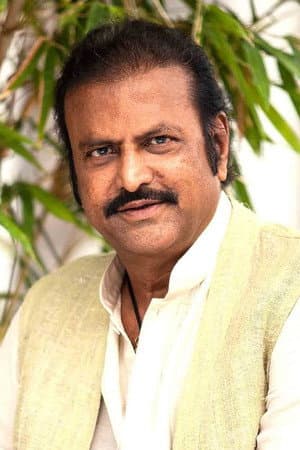
Some careers are best understood through a single name. Others need two. The performer Telugu cinema knows as Mohan Babu was born Bhaktavatsalam Naidu in Modhugulapalem, a village on the banks of the Swarnamukhi, the river that runs between the pilgrim towns of Tirupati and Sri Kalahasti. The birth name was chosen in reverence, and it is a long, formal thing. The screen wanted something shorter and sharper. That exchange, a village name for a working name, opens a body of work now stretching across five decades of Telugu cinema.
Following this career takes one piece of industry vocabulary. Telugu cinema, like the other large Indian film industries, divides its performers into leads and character artists: the term for performers who specialise in supporting parts rather than central ones. What sets the character artist apart in Telugu film is the room the industry gives them. A supporting part here is not a small part. It can carry a film's authority, its comedy or its moral weight, and a performer who holds that space becomes as recognisable as any lead. Mohan Babu: A Career In Telugu Cinema is, in the end, the story of a performer who used exactly that space.
A Career, Not a Comeback
The filmography is continuous. It runs from the early 1980s into the 2020s, and it reads better as one long working record than as a series of departures and returns. A pattern holds across it. He tends to be the figure who carries authority in a story, and that authority takes different shapes: divine, social, comic, sometimes all three inside the same film. The titles confirm it. A village drama, a devotional epic, a comedy about the god of death and a portrait of the industry's own past all sit on the same list, and the same face anchors each of them.
The Films and What Each One Carries
The record begins early. Gharana Donga (1980), with the performer credited as Kishore Kumar, is an early entry, worth noting simply as evidence of how far back the list reaches. By the mid 1990s he was a settled presence in commercial drama. M Dharmaraju M.A. (1994) and Rayudugaru Nayudugaru (1996) belong to that register, the kind of titles that built and sustained a mainstream following. Veedevadandi Babu (1997) continues it, and Mesthri (2009) carries the same presence into a later decade, its title naming a working man, the mesthri, or foreman, a word every Telugu viewer would recognise from a building site.
Then there is the comedy that made the authority funny. In Yamadonga (2007) he plays Yama Dharma Raja, the god of death, in a film where an orphaned thief named Raja dies during a kidnapping plot and argues his way back to life from Yamlok, the realm of the dead in Hindu myth. Playing that figure for laughs takes a performer an audience will accept as the lord of the dead and still enjoy watching lose an argument.
The devotional strand proves just as durable. Jagadguru Adi Shankara (2013), as Rudraksha Rushi, sits on that side of the ledger. So does Shaakuntalam (2023), where he appears as Sage Durvasa, a sage whose temper is a fixed point of tradition and therefore a gift to any performer. Srinivasa Mangapuram (2026), as Venkatappaya Naidu, returns to the religious register once more, its title signalling exactly the world it belongs to.
The other side is social and comic. Mahanati (2018) is a portrait of Savitri, one of Telugu cinema's most iconic leading women, and in it he plays S. V. Ranga Rao, a celebrated figure of the industry's own past: one performer embodying another. The Paradise (2026) puts him in 1980s Secunderabad as Shikanja Maalik, guiding a marginalised tribe fighting discrimination and a battle for citizenship. It is a social drama rather than a myth. And Kannappa (2025) shows his stake on the other side of the camera, since he appears as Mahadeva Shastri and also serves as producer, a distinct job from performing.
Two Registers
Set the titles side by side and a pattern appears. Myth and devotion on one side. Social and comic authority on the other. Most long careers settle into one register. This one alternates, deliberately and repeatedly, and the alternation is the career.
Where He Sits, and Why the Name Travels
Where does he sit in Telugu cinema? As a long serving performer whose confirmed credits run from the early 1980s to the 2020s, in both devotional and commercial registers, and in more than one job. No ranking is needed and none is implied. For a reader outside the region, though, the value is practical. Following this single body of work is a short course in how Telugu cinema handles its main modes: how it stages myth, how it frames devotion, how it builds comedy out of the divine and how it carries social drama.